
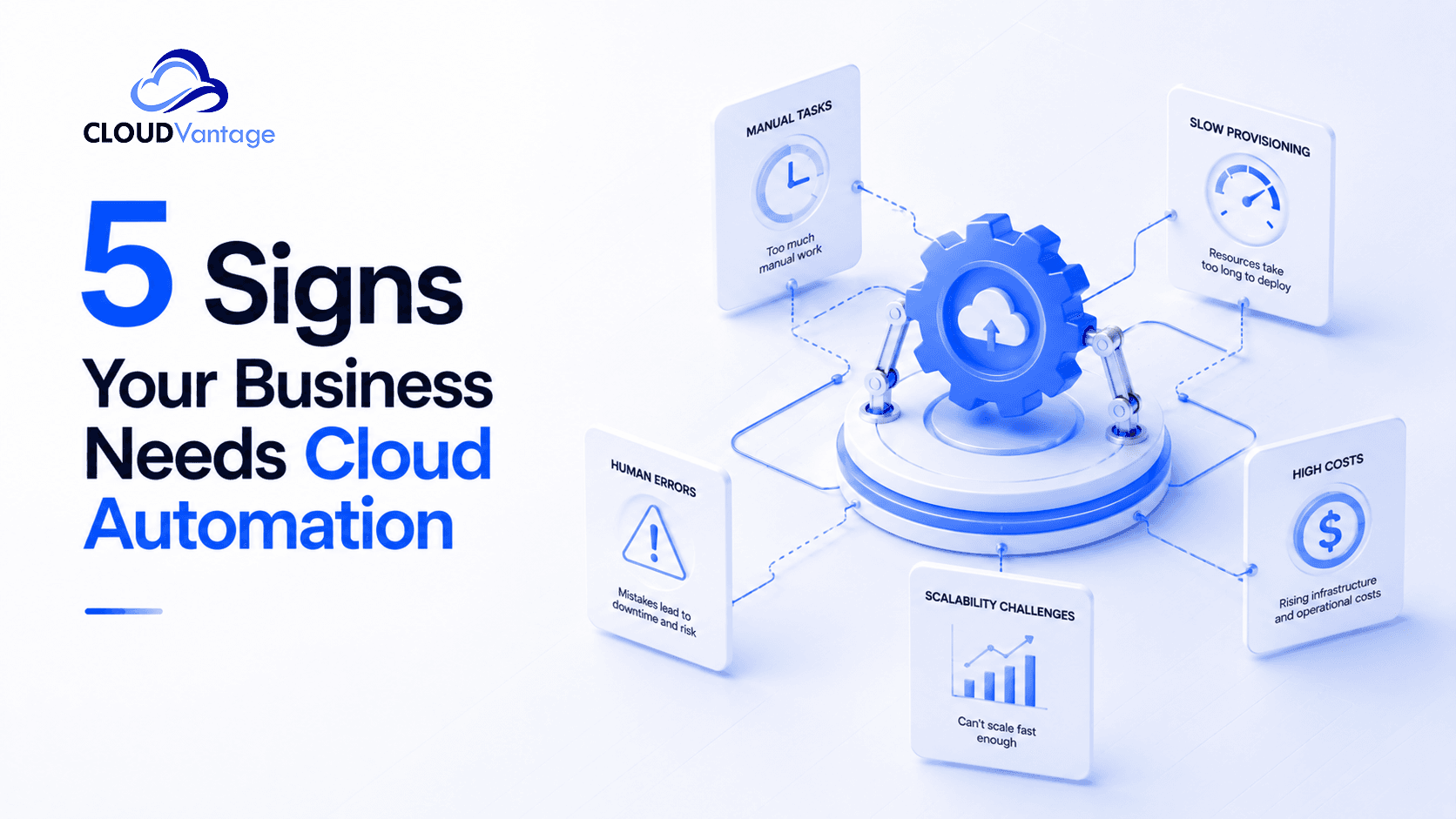
5 Signs Your Business Needs Cloud Automation
Cloud adoption has become the foundation of digital transformation, enabling businesses to innovate faster, improve collaboration, and scale their operations. Yet, for many organizations, moving to the cloud is only the first step.
As cloud environments grow, managing them manually becomes increasingly complex. Routine tasks consume valuable time, deployments slow down, operational risks increase, and IT teams spend more effort maintaining systems than delivering innovation.
Cloud automation helps businesses overcome these challenges by replacing repetitive manual processes with intelligent, automated workflows that improve efficiency, consistency, and scalability.
But how do you know when it's time to automate?
Here are five clear signs your business is ready for cloud automation.
1. Your Team Performs the Same Cloud Tasks Every Day
If your IT team spends hours provisioning virtual machines, configuring networks, updating environments, or managing routine cloud resources manually, valuable time is being lost on repetitive work.
These tasks are necessary, but they don't create competitive advantage.
Cloud automation eliminates repetitive operational work by executing predefined processes consistently and accurately, allowing IT teams to focus on higher-value initiatives like innovation, optimization, and business growth.
Ask yourself:
- Are repetitive cloud tasks consuming your team's day?
- Could those tasks be automated?
If the answer is yes, your organization is ready for automation.
2. Deployments Are Slow and Inconsistent
Modern businesses need to deploy applications, updates, and infrastructure quickly.
Manual deployment processes often create bottlenecks because every step depends on human intervention. This increases deployment times while introducing inconsistencies between environments.
Cloud automation enables standardized deployment workflows, helping organizations:
- Deploy faster
- Reduce configuration drift
- Improve consistency
- Accelerate software delivery
Faster deployments mean faster innovation.
3. Human Errors Are Becoming Costly
One incorrect configuration can lead to downtime, security vulnerabilities, compliance issues, or unexpected service disruptions.
Manual cloud operations naturally increase the likelihood of mistakes because repetitive tasks rely heavily on human input.
Automation replaces manual execution with repeatable, standardized workflows, reducing the risk of configuration errors while improving operational reliability.
The more manual your processes become, the greater your exposure to avoidable risks.
4. Scaling Your Cloud Environment Feels Complicated
Growth should be exciting—not operationally overwhelming.
As organizations expand, cloud infrastructure often becomes more complex. New applications, additional users, and increasing workloads require faster provisioning and better resource management.
Managing this growth manually creates delays and operational overhead.
Cloud automation enables infrastructure to scale efficiently by automatically provisioning, configuring, and managing resources as business demands change.
Instead of reacting to growth, your infrastructure becomes ready for it.
5. Your IT Team Spends More Time Maintaining Than Innovating
Technology teams deliver the greatest value when they're solving business problems, building new capabilities, and enabling innovation.
If most of your team's time is spent monitoring systems, repeating administrative tasks, troubleshooting routine issues, or maintaining infrastructure, innovation naturally slows down.
Cloud automation shifts repetitive operational work to automated workflows, allowing your team to focus on strategic projects that drive business outcomes.
When automation handles routine operations, your people can focus on what matters most.
Why Cloud Automation Matters
Cloud automation isn't simply about reducing manual work.
It helps organizations build cloud environments that are:
- More reliable
- More scalable
- More secure
- More efficient
- Easier to manage
Businesses that automate their cloud operations often experience:
- Faster deployments
- Improved operational consistency
- Reduced human error
- Better resource utilization
- Increased productivity
- Greater agility
In today's competitive environment, automation is becoming a strategic advantage rather than a technical convenience.
Want a deeper understanding of cloud automation and how organizations use it to improve efficiency, security, and scalability? Explore our complete guide, Why Cloud Automation Matters: Benefits, Use Cases & Why Every Modern Business Should Adopt It.
How CloudVantage Helps
At CloudVantage, we help businesses modernize cloud operations through intelligent automation solutions designed for reliability, scalability, and long-term growth.
Whether you're looking to automate infrastructure provisioning, streamline cloud operations, improve deployment workflows, or optimize cloud management, our team works with you to build solutions that support your business objectives.
Our goal isn't simply to automate technology—it's to help organizations operate more efficiently while preparing for future growth.
Frequently Asked Questions
What is cloud automation?
Cloud automation is the use of software, scripts, and automated workflows to perform cloud management tasks with minimal manual intervention.
Why is cloud automation important?
Cloud automation improves efficiency, reduces human error, accelerates deployments, enhances scalability, and allows IT teams to focus on strategic initiatives instead of repetitive operational tasks.
Is cloud automation only for large enterprises?
No. Businesses of all sizes can benefit from cloud automation. As cloud environments grow, automation helps organizations manage resources more efficiently regardless of company size.
What can be automated in the cloud?
Many cloud operations can be automated, including infrastructure provisioning, resource scaling, deployments, configuration management, monitoring, backups, security policies, and routine maintenance tasks.
Final Thoughts
If your organization is experiencing repetitive manual work, slow deployments, recurring operational errors, scaling challenges, or maintenance-heavy IT operations, those aren't just isolated issues—they're indicators that your cloud environment has outgrown manual management.
Cloud automation empowers businesses to operate more efficiently, reduce operational complexity, and build a cloud infrastructure that's ready to support future growth.
The sooner you automate, the sooner your team can focus less on maintaining systems and more on creating value.
If you're still evaluating whether cloud automation is the right investment for your organization, our comprehensive guide, Why Cloud Automation Matters: Benefits, Use Cases & Why Every Modern Business Should Adopt It, explains the business value, practical use cases, and long-term benefits in greater detail.