
7 Cloud Tasks Every Business Should Automate Today
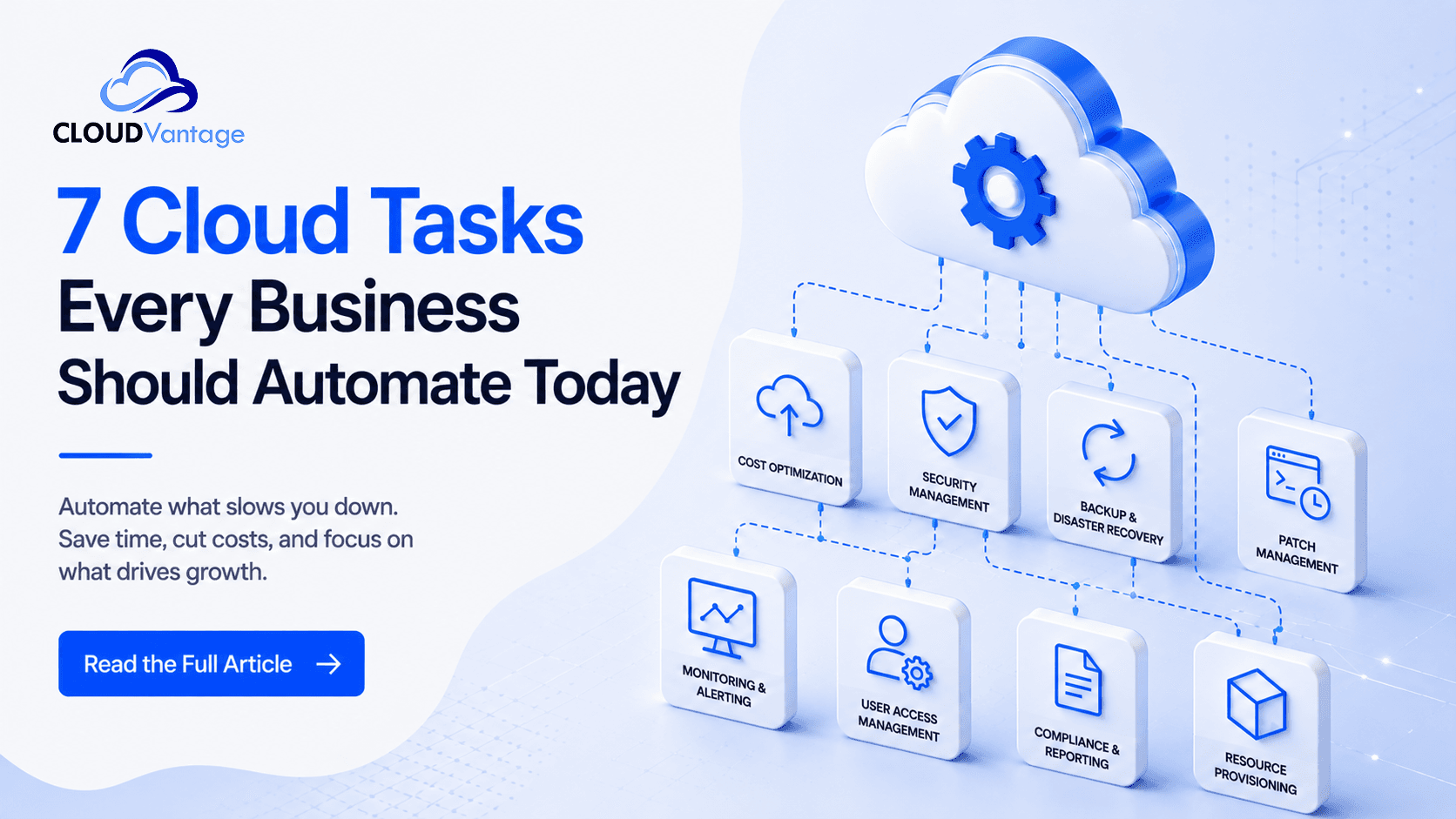
Cloud automation is transforming the way modern businesses manage their infrastructure.
Instead of relying on repetitive manual processes, organizations are automating routine cloud operations to improve efficiency, reduce human error, strengthen reliability, and create more time for innovation.
If you're still exploring why automation is becoming essential, read our guide on Why Cloud Automation Matters to understand how automation helps businesses build faster, more reliable cloud environments.
But where should you begin?
Here are seven cloud tasks every business should automate.
1. Infrastructure Provisioning
Creating virtual machines, storage, networks, and other cloud resources manually takes time and often leads to inconsistencies.
Automating infrastructure provisioning allows organizations to create standardized environments quickly while reducing configuration errors and accelerating project delivery.
When infrastructure can be deployed in minutes instead of hours, your business becomes more agile and responsive.
2. Application Deployments
Manual deployments often slow release cycles and increase the likelihood of deployment failures.
Automated deployment pipelines help organizations deliver updates faster while maintaining consistency across development, testing, and production environments.
Faster deployments mean your teams can deliver value to customers more frequently.
3. Resource Scaling
Business demand changes constantly.
During busy periods, applications require additional computing resources. During quieter periods, excess capacity can increase operational costs.
Automating resource scaling enables cloud infrastructure to adjust according to workload, helping maintain performance while optimizing resource usage.
This ensures your infrastructure supports business growth without unnecessary manual intervention.
4. Monitoring and Alerting
Monitoring cloud infrastructure manually makes it difficult to identify issues before they affect users.
Automated monitoring continuously tracks the health and performance of cloud environments, while intelligent alerts notify teams when predefined thresholds are reached.
This enables faster incident response, improved service availability, and better operational visibility.
5. Backup and Disaster Recovery
Data loss, accidental deletion, cyberattacks, and infrastructure failures can significantly impact business operations.
Automating backup processes ensures that critical data is protected consistently without relying on manual schedules.
Combined with a well-designed disaster recovery strategy, automated backups help organizations recover more quickly and minimize downtime when unexpected events occur.
6. Routine Security Operations
Maintaining a secure cloud environment requires continuous attention.
Many routine security activities can be automated, including:
- Policy enforcement
- Security updates
- Configuration validation
- Compliance checks
- Identity and access monitoring
Automation helps organizations strengthen security while reducing repetitive administrative work.
7. Routine Infrastructure Maintenance
Routine maintenance is essential, but it shouldn't consume most of your IT team's time.
Tasks such as restarting services, applying scheduled updates, cleaning temporary resources, and performing health checks can all be automated.
This allows technical teams to focus on strategic initiatives instead of repetitive operational activities.
Why Automating These Tasks Matters
Automating cloud operations delivers benefits beyond saving time.
Organizations that embrace cloud automation often experience:
- Faster deployments
- Improved operational consistency
- Reduced human error
- Better infrastructure reliability
- Greater scalability
- Improved productivity
- More time for innovation
If several of these tasks are still managed manually in your organization, you may also find our article 5 Signs Your Business Needs Cloud Automation helpful. It explains how to identify when manual cloud operations are limiting business growth.
Where Should You Start?
Not every business needs to automate everything at once.
The most effective approach is to identify repetitive, time-consuming tasks that deliver the greatest operational impact when automated.
For many organizations, infrastructure provisioning, application deployments, monitoring, and backups provide the quickest return on investment.
As your automation strategy matures, additional operational workflows can be incorporated to create a more resilient and efficient cloud environment.
How CloudVantage Helps
Cloud automation is not simply about deploying scripts or scheduling routine jobs.
Successful automation requires the right architecture, governance, monitoring, and operational strategy.
CloudVantage helps businesses design, implement, and optimize cloud automation solutions that improve operational efficiency while supporting long-term growth.
Our cloud automation services help organizations:
- Automate cloud infrastructure
- Accelerate deployments
- Improve monitoring and alerting
- Enable intelligent resource scaling
- Strengthen backup and disaster recovery
- Improve cloud security
- Simplify infrastructure management
Whether you're starting your automation journey or modernizing an existing cloud environment, CloudVantage can help you build infrastructure that's ready for the future.
Frequently Asked Questions
What cloud tasks can be automated?
Many cloud operations can be automated, including infrastructure provisioning, deployments, scaling, monitoring, backups, security operations, and routine maintenance.
Why should businesses automate cloud operations?
Cloud automation reduces repetitive manual work, improves consistency, strengthens infrastructure reliability, and enables businesses to scale more efficiently.
Which cloud task should businesses automate first?
Most organizations begin with infrastructure provisioning, application deployments, monitoring, and backups because these areas often deliver the greatest operational improvements.
Is cloud automation suitable for small businesses?
Yes. Businesses of all sizes can benefit from cloud automation by reducing operational overhead, improving efficiency, and creating a more scalable cloud environment.
Final Thoughts
Cloud automation isn't about replacing people—it's about empowering them.
By automating repetitive cloud tasks, organizations can improve operational efficiency, reduce risk, strengthen infrastructure reliability, and free technical teams to focus on innovation instead of maintenance.
The sooner businesses automate routine cloud operations, the sooner they can build a cloud environment that's ready to support long-term growth.