
5 Warning Signs Your Cloud Infrastructure Isn't Ready to Scale
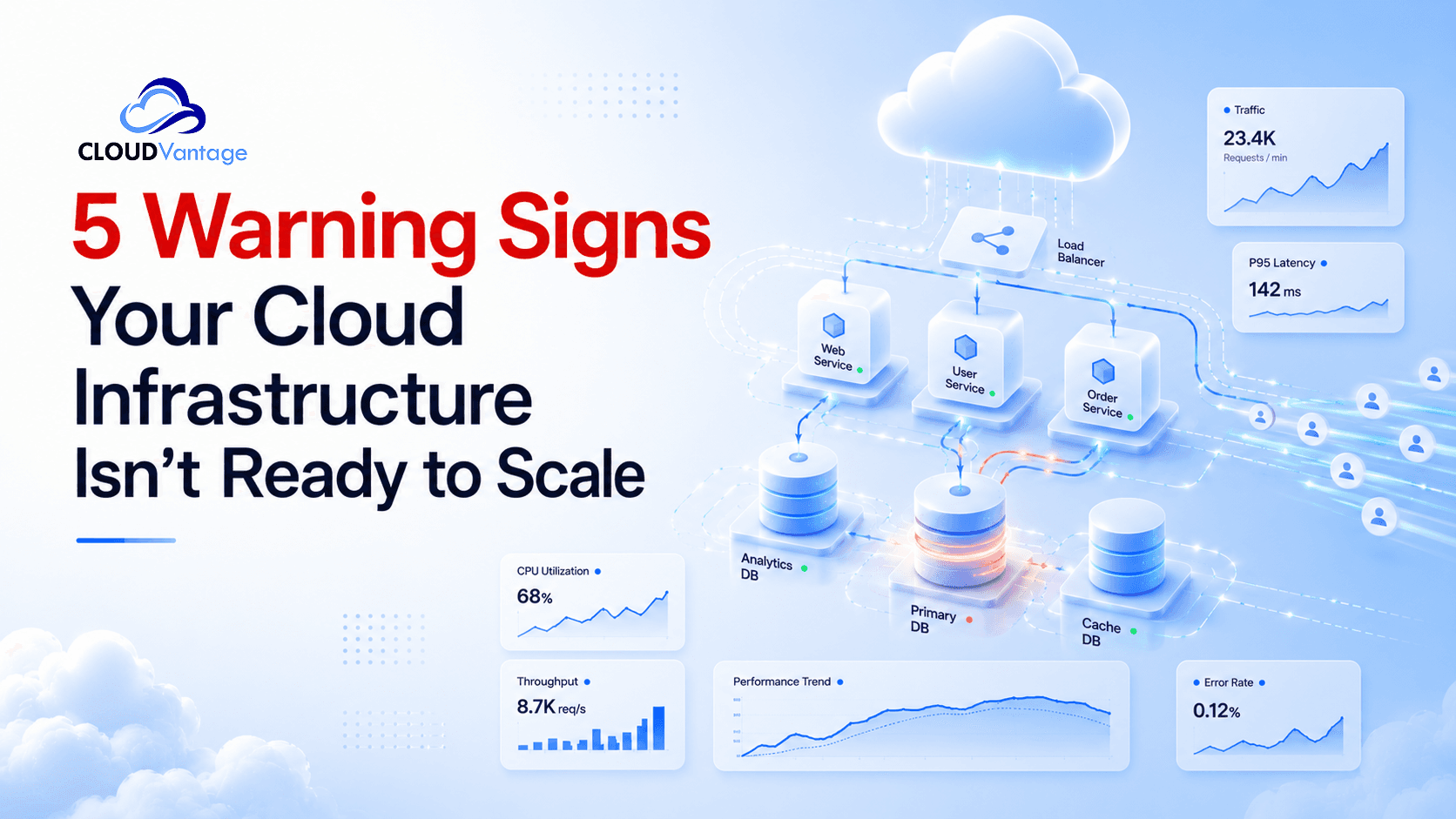
Growth is often seen as a positive challenge for businesses. More customers, more transactions, and more traffic usually mean things are moving in the right direction.
However, growth can also expose weaknesses in your technology stack.
Many businesses assume their cloud infrastructure is ready to scale until demand increases and performance starts to decline. Slow applications, unexpected downtime, rising operational costs, and frustrated users are often signs that the underlying infrastructure was never designed to handle sustained growth.
The reality is simple:
Growth doesn't create infrastructure weaknesses. It exposes them.
If you're a startup, growing business, or enterprise team planning for expansion, here are five warning signs that your cloud infrastructure may not be ready to scale.
1. Traffic Spikes Immediately Affect Performance
One of the clearest indicators of poor infrastructure scalability is when increased traffic causes noticeable performance degradation.
If your application becomes slower whenever user activity increases, your infrastructure may lack the flexibility needed to handle changing workloads.
Scalable cloud infrastructure should be able to respond dynamically to demand by allocating resources when needed and reducing them when demand decreases.
This is where technologies such as scalable virtual machines become essential. Businesses that rely on fixed infrastructure often struggle during periods of rapid growth because their systems cannot adjust fast enough.
For a deeper look at how scalable infrastructure supports growing businesses, read our guide on Scalable Virtual Machines for African Startups and Growth.
2. You Discover Problems After Users Complain
Many businesses only become aware of infrastructure issues after customers report them.
By the time users notice slow performance, failed transactions, or service interruptions, the problem has already started affecting customer experience and potentially revenue.
Modern cloud environments rely heavily on monitoring, observability, and alerting systems to identify issues before users encounter them.
Proactive infrastructure visibility allows teams to respond to abnormal resource consumption, latency increases, and application bottlenecks before they become critical incidents.
If your current setup depends on customers reporting issues first, your infrastructure visibility strategy likely needs improvement.
3. Scaling Depends on Manual Intervention
Does someone on your team need to manually increase resources every time demand grows?
If the answer is yes, scalability becomes a risk.
Manual scaling introduces delays, increases operational complexity, and leaves room for human error. As businesses grow, infrastructure should be able to respond automatically to changing workloads.
Cloud environments designed for scalability use automation to ensure resources remain aligned with demand.
Manual intervention may work when user volumes are low, but it becomes increasingly difficult as applications, databases, and workloads expand.
Businesses that adopt cloud management best practices are typically better positioned to automate infrastructure operations and support long-term growth.
You may also find value in our article on Nigeria's Best Cloud Management Service Provider, which explores the role of cloud management in maintaining reliable infrastructure.
4. A Single Failure Can Affect Multiple Services
A resilient cloud infrastructure should never depend entirely on a single component.
If one overloaded server, application instance, or service disruption can impact your entire platform, you may have a significant scalability problem.
This often happens when businesses lack redundancy and proper traffic distribution mechanisms.
Load balancing is one of the most effective ways to improve reliability by distributing traffic across multiple resources instead of relying on a single point of failure.
When implemented correctly, load balancing improves performance, availability, and resilience during periods of increased demand.
Learn more about how traffic distribution improves infrastructure resilience in our guide to Load Balancing.
5. Your Database Becomes the Bottleneck
Applications can only perform as well as the databases behind them.
As user activity grows, poorly optimized or difficult-to-manage databases often become one of the first scalability challenges businesses encounter.
Common warning signs include:
-
Slow queries
-
Increased response times
-
Performance degradation during peak periods
-
Resource-intensive maintenance
Managing databases manually can quickly become a burden as workloads increase.
Database as a Service (DBaaS) solutions help businesses simplify database operations while improving scalability, reliability, and performance.
If database management is becoming increasingly complex, explore our article on What Is Database as a Service (DBaaS)? to understand how managed database solutions can support growth.
Why Infrastructure Scalability Matters
Scalability is not simply about handling more users.
It's about maintaining performance, reliability, and customer experience as demand increases.
Businesses that invest in scalable cloud infrastructure are better equipped to
-
Maintain application performance
-
Reduce downtime risks
-
Improve operational efficiency
-
Respond to growth faster
-
Deliver better user experiences
-
Control long-term infrastructure costs
The earlier scalability issues are identified, the easier and less expensive they are to address.
Conclusion
Cloud infrastructure problems rarely appear overnight.
Most scalability challenges begin as small operational issues that become more visible as demand grows.
If you've identified one or more of the warning signs discussed in this article, it may be time to evaluate whether your infrastructure is prepared for the next stage of growth.
At CloudVantage, we help businesses build cloud infrastructure designed for scalability, reliability, visibility, and performance.
From load balancing and infrastructure monitoring to scalable virtual machines and managed database solutions, our platform is built to support businesses as they grow.
Explore CloudVantage's cloud infrastructure solutions and discover how to scale with confidence.